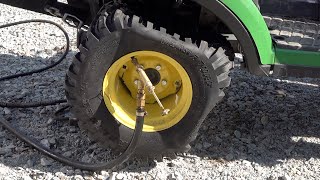
Filmed at a commercial tire shop, this video follows a professional tire technician filling Rim Guard into multiple compact and subcompact tractors across a real service visit. It covers the fill method (valve stem at top, fluid to overflow), gallonage and weight figures from the Rim Guard chart, calcium vs. Rim Guard trade-offs, valve stem type considerations, and why some tractors were skipped. Most useful for owners deciding whether to DIY or hire out the job.
Tractor Time with Tim is an owner-operator channel focused on compact tractors, presenting projects from a hands-on hobbyist perspective rather than a dealership or manufacturer standpoint.
What this video covers
Valve stem positioned at top, fluid filled until it overflows
16.9x28 tire takes 69 gallons, about 73.8 pounds per tire
Shop rarely uses calcium anymore, converts customers to Rim Guard instead
Rubber pull-through valves fine up to about 45 to 55 PSI rated tires
One tractor left without fluid since it is used for turf work
Questions this video answers
How much Rim Guard does a 16.9x28 compact tractor tire need?
According to the Rim Guard fill chart, a 16.9x28 tire takes 69 gallons, which comes out to 73.8 pounds per tire.
Does Rim Guard damage rubber valve stems like calcium does?
The technician says he has never seen Rim Guard cause that problem, only calcium, which reacts with the brass fitting and causes it to separate.
Should every tractor tire get filled with Rim Guard ballast?
No. One tractor used mainly for turf applications was left without fluid because its duals are taken on and off and would be too heavy to handle with fluid in them.
When should you use a high-pressure steel valve instead of a rubber pull-through?
Only when the tire recommends 65 PSI or more, since most rubber pull-through valves only handle up to about 45 to 55 PSI.