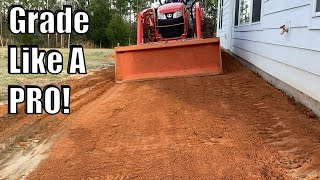
A real-world grading job filmed as it happens: the creator is backfilling around a new house foundation to meet building code clearance (6 inches below the siding), using a front-end loader bucket. Practical tips include reading bucket level without a level indicator, working close to a house without hitting it, and using the backhoe end to pack soil tight against the foundation. Closes with honest cost math, roughly $2,200 in labor and materials, making it useful for homesteaders weighing DIY tractor work against hiring out.
An owner-operator homesteader sharing hands-on experience from their own property, with no apparent commercial or dealer affiliation.
What this video covers
Code requires 6 inches foundation showing below Hardy board siding
Reads bucket level using flat spot on top of bucket
Avoids filling around water pipes and sewage cleanout pipes
Uses backhoe end to pack soil tight against foundation
Removes bucket to get tractor closer to house for packing
Estimates job at about $2,200 in labor and fill dirt
Questions this video answers
How do you tell if a loader bucket is level without a bucket level indicator on a Kubota?
Look at the flat spot on top of the bucket from the tractor seat; keeping that flat spot level gives a visual plane showing the bucket is going into the pile straight.
How much foundation clearance do you need when grading dirt against a house?
The builder required 8 inches from the bottom of the Hardy board, allowing 2 inches for sod so nothing sits closer than 6 inches from the foundation or siding bottom.
How do you pack fill dirt tight against a house foundation with a tractor?
Take the bucket off so the tractor can get closer, then use the end of the backhoe to create holes in the dirt and pack it, adding fill on top and repeating.
Is it cheaper to grade dirt around a foundation yourself or hire it out?
The creator estimated 10 to 12 hours of tractor time worth about $1,500 in labor plus $675 of fill dirt, totaling roughly $2,200 for the job.