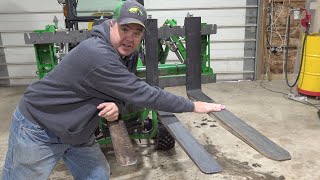
Rather than a general pallet-fork overview, this video argues one specific case: why 36-inch forks beat 42-inch forks on subcompact tractors. The host physically mounts three different fork sizes on an Artillian frame, demonstrates each point side-by-side, and runs an informal scale test showing roughly a 50-pound lift-capacity difference. Covers visibility, maneuverability, dump height, weight, leverage for lifting, and digging. Best for subcompact owners deciding between fork lengths.
Tractor Time with Tim is an owner-operator channel focused on compact tractors, presenting personal hands-on experience rather than a dealership or manufacturer perspective.
What this video covers
A 3 by 4 inch wide fork is unnecessary on a subcompact or B series Kubota
36 inch forks fit a 47 inch pallet with room to spare
Shorter forks need less backing-up room to clear a load
42 inch forks sit closer to ground, making sticky loads harder to dump
36 by 3 forks weigh 112 pounds, 8 pounds less than the 42 inch pair
Scale test showed about a 50 pound lift capacity loss with longer forks
Questions this video answers
Are 36 inch or 42 inch pallet forks better for a subcompact tractor?
The host prefers 36 inch forks for subcompact tractors, citing better maneuverability, lighter weight, higher dump height, and more lift capacity, though 42 inch forks offer slightly better visibility.
How much does fork length affect lift capacity on a tractor?
An informal scale test repeated several times showed about a 50 pound difference, roughly a 10 percent loss of leverage, when lifting with the longer fork tip versus the shorter one.
Do I need 4 inch wide pallet forks on a subcompact tractor?
No. The host says there is no use for a 4 inch wide fork on a subcompact or 2 Series tractor or B series Kubota, and 3 inch wide is all you will ever need.
Will a 36 inch fork fit a standard pallet?
Yes. On a 47 inch wide pallet, the 36 inch fork still sticks through plenty far, though the 42 inch fork extends a bit further out the back.